
© 2024 fjorge. All rights reserved.
5 things to know before your developer stops answering
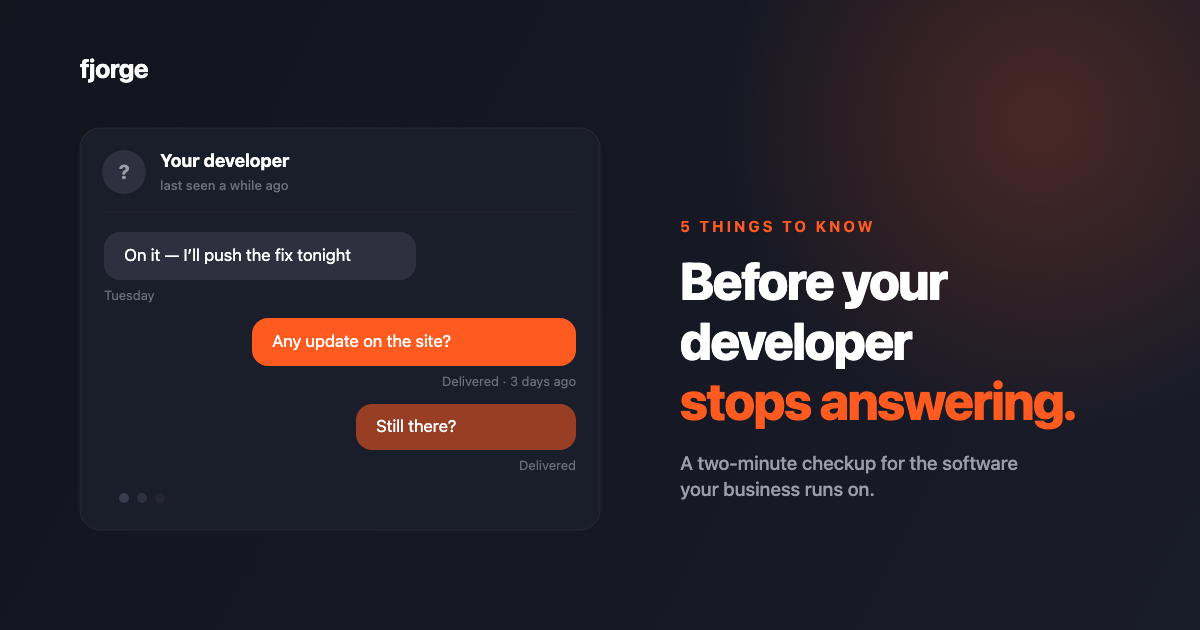
It rarely happens with a dramatic goodbye. The replies just get slower. A day, then a week, then the “I’ll get to it!” stops coming at all. Maybe they took a full-time job, maybe they burned out — it doesn’t really matter why.
What matters is the question hiding underneath it: if the person who built my software disappeared tomorrow, would I be okay?
The good news is you can answer that today, calmly, before anything goes wrong. Here are the five things worth knowing now — while you still have someone to ask.
1. Whose name your accounts are actually in
Your software sits on top of a handful of accounts: the place it lives (its hosting), the registration for your web address (your domain), your email, and the various tools wired in behind the scenes.
If those are in your company’s name, a developer leaving is an inconvenience. If they’re in the developer’s name, you can be locked out of your own business — and getting back in can mean weeks of support tickets and proof-of-ownership paperwork.
Quick gut check: could you log into your hosting account in the next ten minutes? Do you even know where it is?
2. Whether anything is written down
Imagine handing your software to a developer you just met. What would you give them?
If the answer is “a login and a phone number that no longer works,” that’s the gap to close — and it has nothing to do with how good the work is. The work could be excellent. But if how it’s built and where things live only exists in one person’s head, every new person has to reverse-engineer it before they can safely touch anything. That’s slow, expensive, and risky.
The unglamorous word for this is “documentation.” A friendlier way to think about it: the difference between handing someone a recipe and asking them to guess what’s in the cake.
3. Whether your data could survive a bad day
Ask one simple question: if our information disappeared or got scrambled tomorrow, could we get it back?
“I think we have backups” is not a yes. A real yes sounds like: backups happen automatically on a schedule, someone has actually tested that they work, and you know what you’d be able to recover. Plenty of businesses discover the gap between those two answers at the worst possible moment — when the person who would’ve known is already gone.
4. How you’d find out something broke
Right now, how do you learn when something’s wrong with your software? For a lot of people, the honest answer is “a customer tells me,” or “I notice when I’m using it myself.”
That means you’re finding out after it’s already cost you something. A healthier setup watches itself and sends an alert the moment something goes down — so a problem gets caught while it’s small, instead of after it’s become a bad review. You don’t need to understand how that works. You just need to know whether it’s switched on.
5. Who you’d call, and how fast they’d answer
This is the one people assume they’ve handled, right up until they need it.
If your software went down tonight, do you know exactly who to call — and roughly how quickly it would come back online? Not “I’d figure it out,” but an actual answer you’ve agreed on in advance. Knowing who’s responsible before the emergency is the difference between a stressful evening and a genuine crisis.
This is also where one-person setups quietly fail. If the only name on your list is the person who’s no longer answering, you don’t really have a plan. You have a hope.
None of this requires understanding code
That’s the part worth repeating. Every item on this list is a business question, not a technical one. You don’t need to read a line of code to know whether your accounts are in your name, whether your data is backed up, or whether someone’s watching for trouble.
You just need to actually check — instead of assuming it’s handled because it’s been working so far.
Want to know where you stand in two minutes?
We turned these questions (and a few more) into a free, two-minute self-assessment. It gives you a single, plain-language score for how healthy and resilient your software setup really is — a bit like a credit score, but for your technology. No jargon, no signup to see your result, and nobody calling you afterward unless you ask.
Take the FjCO Score quiz → and find out whether you could hand your software to someone new tomorrow.
Because the best time to answer that question is while you still have someone to ask.
Ready to start a project?

