
© 2024 fjorge. All rights reserved.
Build or Buy? How to Make Smarter Software Decisions in 2025
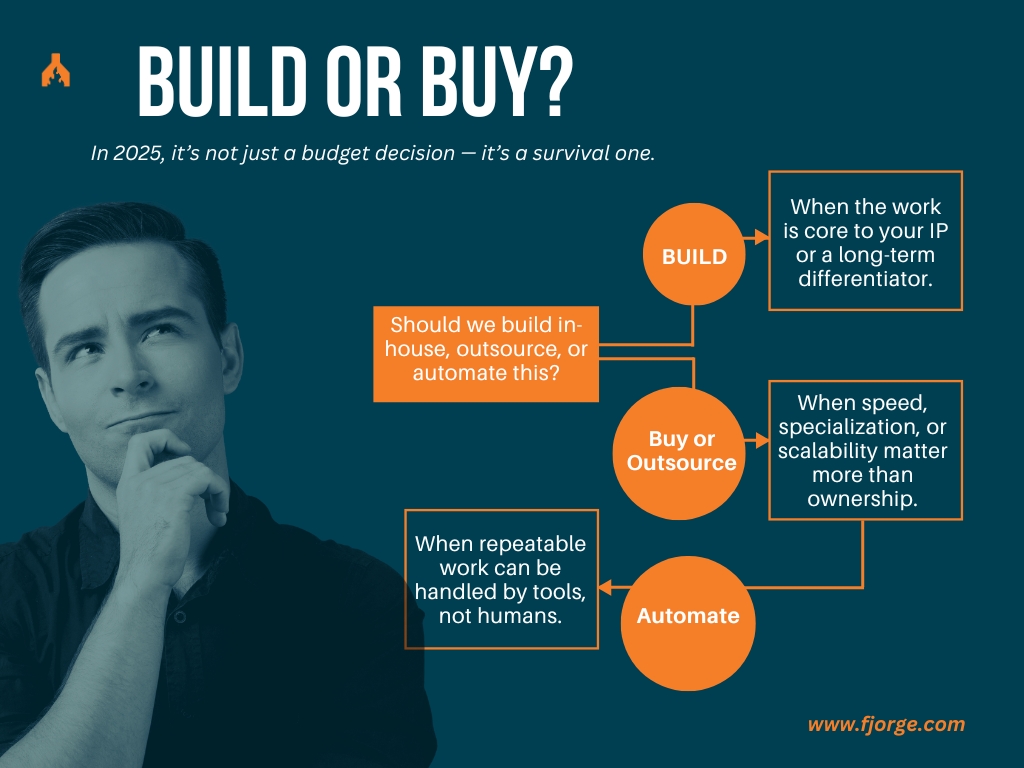
When you need new software, the first question is usually: "Should we build this ourselves, buy something off the shelf, or automate what we already have?"
It's a fair question. And it comes up more often now than ever — because the options have never been wider, and the stakes have never been higher.
The answer isn't always the same. It depends on your business, your goals, and what you're actually trying to solve. But here's a framework that can help you think through it clearly, even if you're not a technical person.
When building makes sense
If what you need is central to how your business operates — and no existing tool quite fits — building custom software is often the right call.
Think of it this way: if the software is your competitive advantage, you probably don't want to run it on the same platform your competitors use. A custom-built tool can be designed around exactly how your team works, instead of forcing your team to work around someone else's design.
Building takes more time upfront. But what you get is software that fits your business like it was made for it — because it was.
Good fit for building:
- Customer-facing portals or apps that need to reflect your brand and workflow
- Internal tools that connect systems no off-the-shelf product was designed to connect
- Processes unique enough that existing software would need heavy customization anyway
When buying makes sense
Not everything needs to be custom. If a well-established tool already does what you need — and does it well — buying saves you time, money, and maintenance headaches.
The key question is: how much customization would you need? If an off-the-shelf tool gets you 80–90% of the way there with minimal configuration, that's usually the smart move. Where it gets tricky is when you're buying a tool and then spending months (and significant budget) customizing it to fit. At that point, you may have been better off building.
Good fit for buying:
- CRM, email marketing, and analytics platforms
- Accounting and HR systems
- Project management and communication tools
When automating makes sense
Sometimes the answer isn't new software at all — it's making your existing systems work harder.
If your team spends hours on repetitive tasks — moving data between systems, generating reports, sending follow-up emails — automation can free them up to focus on work that actually requires a human. The investment is usually smaller than a full build, and the impact can be felt almost immediately.
Good fit for automating:
- Data entry and transfer between systems
- Report generation and distribution
- Customer follow-ups and notifications
- Routine approvals and workflows
The real answer: it's usually a combination
Most businesses don't need to pick just one. The smartest approach is usually a mix — buy the tools that work well out of the box, build the pieces that make your business unique, and automate the repetitive work that connects everything together.
The challenge is knowing which is which. That's where having a partner who understands both the technology and your business goals makes a real difference. Not someone who pushes you toward the most expensive option, but someone who helps you see the full picture and make a decision you'll feel good about a year from now.
What to ask before you decide
Before you commit to building, buying, or automating, run through these questions:
- Is this core to our business? If yes, lean toward building. If not, lean toward buying.
- Does an existing tool do 80%+ of what we need? If yes, buy it. If you'd need heavy customization, consider building.
- Are we spending significant time on repetitive manual work? If yes, automate first — it's often the fastest win.
- What's our timeline? Buying is fastest. Automating is usually next. Building takes the most time but delivers the most tailored result.
- What happens in two years? Will this decision still serve us as the business grows?
If you're weighing a build-or-buy decision right now and want a clear-eyed perspective, we'd be happy to talk it through. No pitch — just a conversation about what makes sense for your situation.
Ready to start a project?

